

Losing hair soon after a hair transplant is common and usually temporary. The transplanted hairs often shed in the first few weeks, but the follicles beneath them stay in place and begin a new growth cycle. Fresh hair usually starts to appear at around three months, and the full result shows at around 12 months.
This article explains why it happens, how it differs from shock loss in your original hair, and when to ask your surgeon.
Why does transplanted hair fall out after the procedure?
Every hair grows in a cycle. There is a long growing phase, a short changeover phase and a resting phase. After resting, the hair falls out and a new one starts.
Moving a follicle is a big disturbance. Many transplanted follicles respond by entering the resting phase and letting go of their hair shaft.
The key point is that the hair shaft is shed, not the follicle. The follicle stays rooted in its new place, resting and preparing to grow a fresh hair. On its own, early shedding is not a sign that the grafts have failed.
Shedding does not look the same for everyone. Some people notice short hairs coming away with the crusts or on the pillow. Others see the transplanted hairs thin out gradually over a few weeks.
What is shock loss in the original hair?
Shock loss can also affect existing hair near the treated area. The procedure can disturb neighbouring follicles, and some of them may shed their hairs for a while.
It tends to be more noticeable when new grafts are placed between existing hairs that are already thinning. This is often the case for women, whose thinning usually spreads across the top rather than leaving bare areas.
Occasionally, a few hairs around the donor area at the back of the head shed for a while too. In many cases, original hair that sheds this way, near the grafts or at the back, grows back over the following months.
Hairs that were already very fine and weak may not always return. That is one reason a careful surgeon plans ahead. Transplanted follicles normally keep growing for life, but the original hair can keep thinning with age.
When does the new hair grow back?
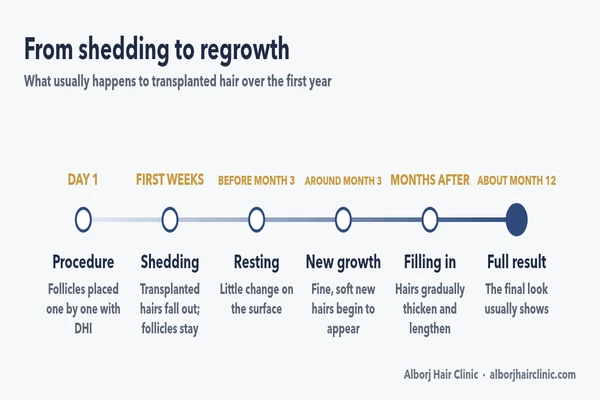
Patience is the hardest part. The pattern below is typical, but everyone grows at a slightly different pace.
- The first few weeks. Transplanted hairs often shed, and the scalp can look much as it did before surgery.
- The weeks that follow. The follicles rest below the skin, so little seems to happen on the surface.
- Around three months. New growth usually starts. The first hairs are often fine and soft.
- The months after. The hairs gradually thicken and lengthen, and the area fills in.
- Around 12 months. The full result usually shows.
Growth is rarely perfectly even. Some areas may fill in sooner than others, so a patchy look in the middle months is common and usually evens out with time.
“Shedding in the first weeks is the stage that worries patients most, yet it is expected. The follicles are still there, resting, and new hair usually starts to come through at around three months.”
How should you look after your scalp while you wait?
Gentle, steady aftercare protects the follicles while they rest. Your clinic’s written instructions come first, but these habits help:
- Wash only the way your clinic shows you, especially in the first days.
- Let shed hairs come away naturally rather than tugging at them.
- Keep the scalp out of strong sun. Many clinics advise shade, or a loose hat once it is allowed, but follow your own surgeon’s timing.
- Ask your clinic before colouring or chemically treating your hair.
Try not to judge the result too early. Checking the mirror every day in the first months tends to add worry, not information.
A simple style change can help in the quiet months. Keeping the surrounding hair a little longer, or changing your parting, can soften the look of the treated area.
It also helps to know the dip is coming. Many people find the weeks between shedding and regrowth the hardest part emotionally, so plan for them rather than being caught off guard.
Can shock loss be prevented?
Not always. Surgeons try to limit it with careful planning and gentle handling of the existing hair around each graft, but some shedding can still happen.
Your part is to follow the aftercare instructions closely and avoid anything that rubs or pulls on the treated area. Tell your surgeon about any recent illness, major stress or change in medicines, as these can also affect shedding.
When should you ask your surgeon?
Shedding on its own is expected, but some changes are worth raising sooner:
- Shedding outside the treated area that seems heavy or keeps going.
- Bald patches that appear suddenly.
- Little or no new growth by the point your surgeon told you to expect it.
- Redness, heat, pus, worsening pain or a fever, which can be signs of infection and need prompt contact.
Your surgeon can examine the scalp and tell you whether things are on track. Follow-up checks exist for exactly this kind of question.
About Alborj Hair Clinic
Alborj Hair Clinic is a hair transplant clinic in Mazaya Centre, Al Wasl, Dubai. Its surgeon, Dr Dimitrios Ziakas, has 24 years of experience and has performed more than 4,000 hair transplant procedures. He is a member of the International Society of Hair Restoration Surgery (ISHRS) and uses the DHI (Direct Hair Implantation) technique.
The clinic’s website includes before-and-after case studies that show how results look once the new hair has grown in.
Frequently asked questions
Does hair lost to shock loss come back?
In many cases, yes. Original hairs that shed after surgery often regrow over the following months, though hairs that were already very weak may not.
Do all transplanted hairs shed?
Not always. Many shed in the first few weeks, while some people keep part of their transplanted hair. Either is normal.
Does early shedding mean the transplant has failed?
No. Early shedding of transplanted hairs is expected, because the follicles stay in place and rest before growing new hair.
When will I know how my transplant has turned out?
Most people see the full result at around 12 months. Judging it then, rather than in the early months, gives a fairer picture.
